
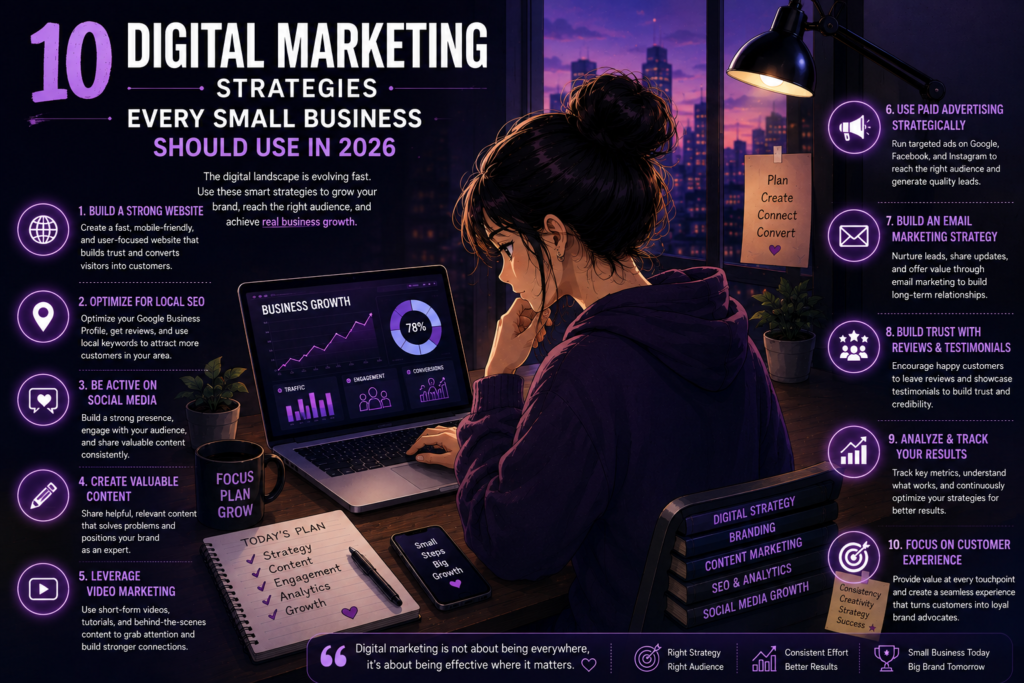
10 Digital Marketing Strategies Every Small Business Should Use in 2026
In 2026, having a strong online presence is no longer optional for small businesses. Customers are increasingly using search engines, social media, websites, reviews, and online communities to discover businesses, compare options, and make purchasing decisions.
For small businesses, digital marketing provides an opportunity to compete with larger brands without requiring an enormous marketing budget. The key is to focus on the right strategies, understand your audience, and consistently measure what works.
Here are 10 digital marketing strategies every small business should consider using in 2026.
1. Build a Strong and Professional Website
Your website is often the first place potential customers go after discovering your business.
A professional website should be:
- Mobile-friendly
- Fast-loading
- Easy to navigate
- Visually appealing
- Optimized for search engines
- Clear about your products or services
- Equipped with strong calls to action
Your website should not simply provide information. It should guide visitors toward taking action, such as contacting you, making a purchase, booking a service, or requesting a quotation.
2. Invest in Local SEO
For businesses serving a specific city or region, local SEO can be extremely valuable.
When people search for terms such as “digital marketer near me,” “best salon in Calicut,” or “restaurants near me,” search engines use location-related signals to provide relevant results.
Small businesses can improve their local visibility by:
- Optimizing their Google Business Profile
- Keeping business information accurate
- Adding relevant business categories
- Collecting genuine customer reviews
- Creating location-focused website content
- Using local keywords naturally
- Maintaining consistent contact information online
A strong local SEO strategy can help your business reach people who are already searching for the products or services you provide.
3. Use Social Media Strategically
Social media is more than a platform for posting promotional content. It is an opportunity to build relationships with your audience.
Instead of posting only about your products or services, create a balanced content strategy that includes:
Educational content: Tips, tutorials, guides, and useful information.
Engaging content: Questions, polls, stories, and interactive posts.
Behind-the-scenes content: Show the people and processes behind your business.
Promotional content: Introduce products, services, offers, and new launches.
Social proof: Share testimonials, reviews, and customer experiences.
Consistency is important, but quality and relevance matter more than simply posting every day.
4. Create Valuable Content
Content marketing helps businesses attract people before they are ready to buy.
For example, instead of simply promoting a skincare product, a skincare brand could create content about:
- How to build a skincare routine
- Common skincare mistakes
- How to choose products for different skin types
- Ingredients customers should understand
- Seasonal skincare tips
This type of content can attract potential customers through search engines and social media while establishing the brand as a useful and trustworthy resource.
5. Focus on Short-Form Video
Short-form video continues to be an important part of digital marketing.
Platforms such as Instagram, YouTube, and other social channels allow businesses to communicate their message quickly and creatively.
Small businesses can create videos such as:
- Product demonstrations
- Quick tutorials
- Customer testimonials
- Before-and-after content
- Behind-the-scenes videos
- Frequently asked questions
- Industry tips
- Brand stories
You don’t always need expensive equipment. A clear message, good lighting, useful content, and consistent publishing can make a significant difference.
6. Use Paid Advertising Wisely
Organic marketing takes time. Paid advertising can help businesses reach targeted audiences more quickly.
Platforms such as Google Ads and social media advertising can be used to promote:
- Products
- Services
- Website pages
- Lead-generation forms
- Special offers
- Events
- New launches
However, successful advertising is not simply about spending more money.
A good campaign requires the right audience, offer, creative, landing page, budget, and tracking system.
Small businesses should start with a clearly defined objective and continuously optimize campaigns based on performance data.
7. Build an Email Marketing Strategy
Social media followers belong to a platform, but your email list is an audience you can communicate with directly.
Email marketing can help businesses:
- Build long-term relationships
- Promote new products
- Share useful content
- Send personalized offers
- Re-engage previous customers
- Increase repeat purchases
A simple email strategy can begin with a newsletter or a valuable free resource that encourages website visitors to subscribe.
The goal should not be to send endless promotional emails. Instead, provide useful information and create a reason for subscribers to continue opening your emails.
8. Build a Strong Personal and Brand Identity
People don’t only buy products. They connect with brands, stories, values, and experiences.
A consistent brand identity can make a small business more recognizable and trustworthy.
Focus on elements such as:
- Brand colors
- Typography
- Visual style
- Brand voice
- Photography
- Messaging
- Customer experience
For service-based businesses, personal branding can be particularly powerful. Showing your expertise, personality, experience, and perspective can help potential customers understand why they should choose you.
9. Use Customer Reviews and Social Proof
Before purchasing, many customers look for evidence that a business is trustworthy.
Reviews and testimonials can help reduce uncertainty and influence purchasing decisions.
Encourage satisfied customers to leave genuine reviews on relevant platforms. You can also showcase authentic testimonials on your website and social media.
Social proof can include:
- Customer reviews
- Testimonials
- Case studies
- User-generated content
- Project results
- Customer stories
The important thing is authenticity. Never create fake reviews or misleading claims.
10. Track Your Results and Improve
One of the biggest advantages of digital marketing is the ability to measure performance.
Instead of asking only, “How many people saw my post?”, businesses should look at metrics that connect marketing activity to business goals.
Depending on your strategy, useful metrics can include:
- Website traffic
- Search rankings
- Leads
- Conversion rate
- Engagement
- Cost per lead
- Return on advertising spend
- Email open and click rates
- Customer acquisition cost
Use these insights to identify what is working and what needs improvement.
Digital marketing is not a one-time activity. It is a continuous process of testing, learning, optimizing, and growing.
Final Thoughts
Digital marketing in 2026 is not about being everywhere or following every trend. It is about choosing the right channels, understanding your customers, creating valuable experiences, and consistently improving your strategy.
For a small business, even a focused approach to SEO, social media, content marketing, video, paid advertising, email marketing, local SEO, and analytics can create meaningful opportunities for growth.
The most successful businesses will be those that don’t simply chase trends but use digital marketing strategically to build visibility, earn trust, connect with customers, and turn attention into long-term business growth.
Ready to strengthen your business’s online presence? A well-planned digital marketing strategy can help turn your online visibility into measurable growth.